

HEATING SYSTEM
The Governor's Palace designer Alajos Hauszmann anticipated two heating systems. According to the original design, fireplaces with marble finishing were placed in the governor's study, reception room (today, the Red and Green Salons), the White and the Small Salons. All the fireplaces except the one in the White Salon were removed during the 1938 renovation under Italian rule. The chimneys were preserved, but concealed behind the attic façade so as not to disrupt the building’s symmetry.
The Palace’s other heating system involved the use of hot air. Namely, the boiler room in the back of the ground floor was connected by ducts that conveyed hot air to the rooms through metal grills. This was a common, frequently used heating system in the 19th century.
In 1929, Leo Rühr & Co completed their first design for the installation of a hot water heating system with eight radiators installed on the ground floor.
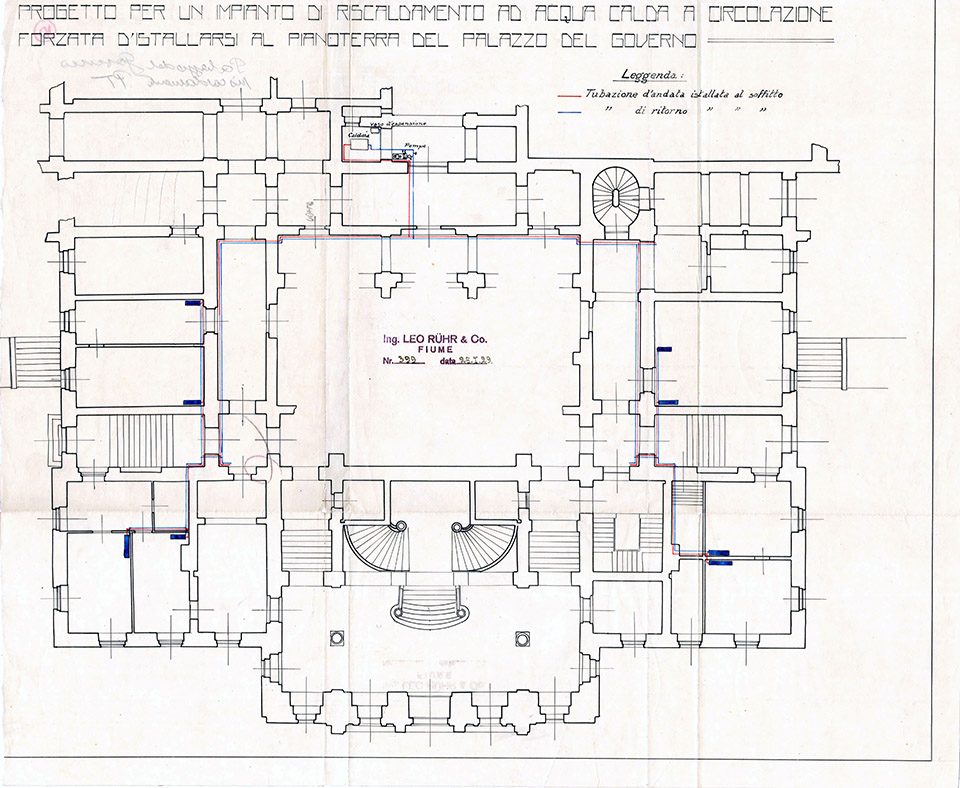
Europe began introducing heating systems with hot water and radiators only in the late 19th century.
In 1938, the same company upgraded the Palace’s heating system and installed new radiators in the window niches of all the rooms (thermosiphon system). A new heating system was also installed in the office building (today the Music School) where rooms had been heated by tile stoves.
Heating presented a significant expenditure; therefore the new system was meant to provide heat as needed. Therefore, after reorganisation, since the period of Italian rule, the eastern wing was intended for use by guests and was heated only when guests stayed there.